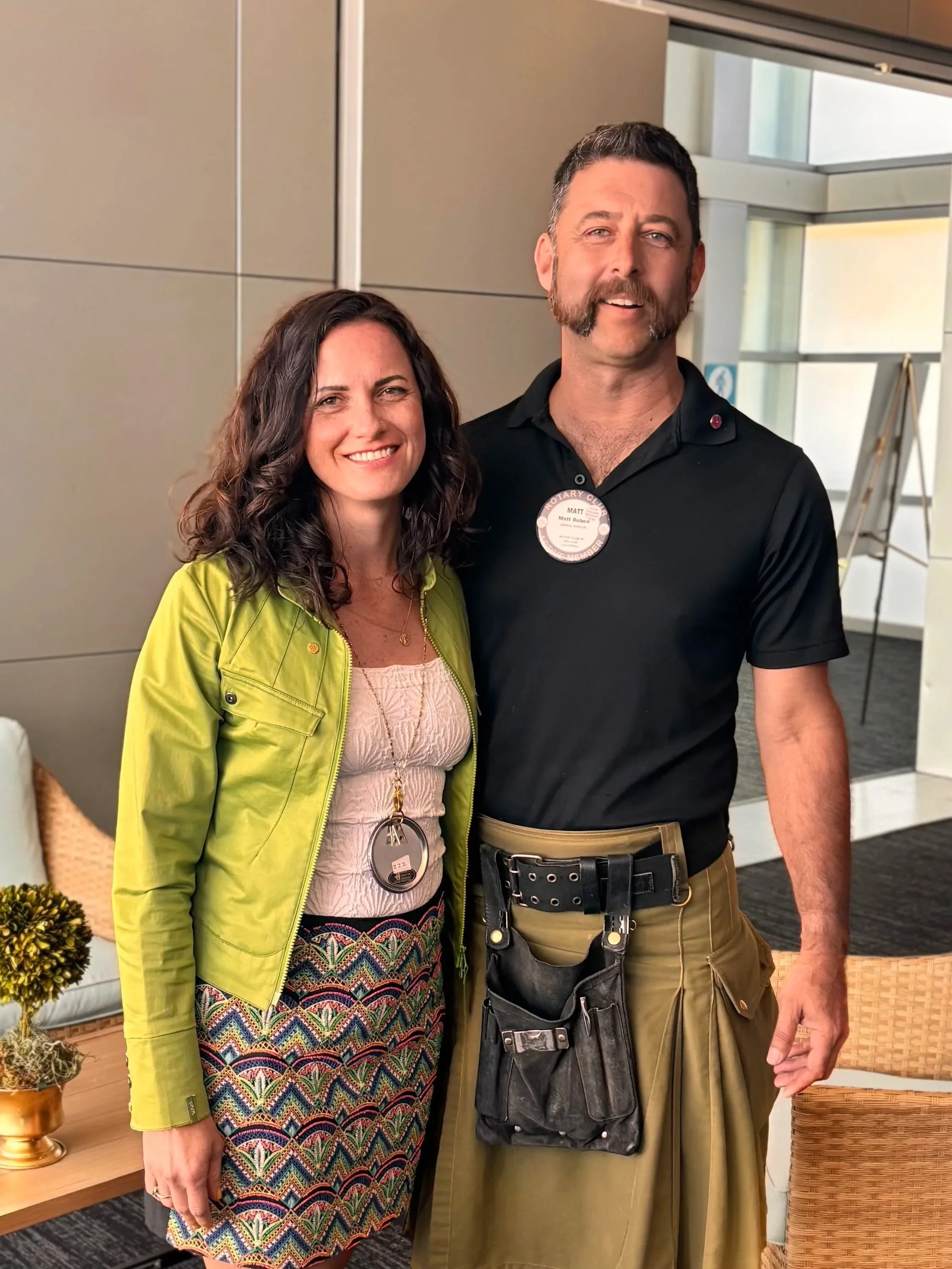
Someone recently told me that Matt Roben was the most interesting man in San José. They might be right.
I have the benefit of also being able to call him a friend and fellow Rotarian. Matt has spent three decades on stages most of us only dream about, performing for crowds of 20,000 at a Chicago Bulls halftime show, gracing the Joffrey Ballet and the original Grand Ole Opry, playing bagpipes in the Tournament of Roses Parade. He spent four years as a Chicago police officer.
He and his wife Emily, a pediatric emergency physician, mentor to the next generation of doctors, casual artist, and by my count possibly the most brilliant woman in San José, co-founded Rancho Roben Rescues with Matt, a 501(c)3 farm animal sanctuary in the east hills of San Jose. Across 12 acres, they've built a home for over 250 rescued animals representing 14 different species. Matt is also a benefit auctioneer who's helped raise millions of dollars for nonprofit organizations.
In early 2026, he went through the Positive Intelligence program. Here's a bit about his story.
What Is PQ, Anyway?
Positive Intelligence (PQ) is a science-based mental fitness program built around a simple idea: most of us are running an old, automatic operating system in our minds, one shaped by fear, self-doubt, and judgment, and we don't even notice it's running the show. PQ calls these patterns "saboteurs." They show up as the voice that says you're not good enough, the one that judges other people, or the one that resists whatever's happening around you.
The program helps you name your own specific saboteurs, catch them in the act, and build a different muscle instead: your "sage," the part of you that leads with clarity, calm, and creativity rather than reaction. It's six weeks of daily practice, about 15 minutes a day, alongside a small group of people doing the same work together.
That's the frame. Here's what it actually looked like for Matt.
The Focus Problem
Matt came to PQ around the same time he started seeing a therapist for the first time. Within five minutes, the therapist asked if he'd ever been evaluated for ADHD. Matt laughed. He'd known since childhood he probably had it, but at nearly 50, he'd never actually talked to anyone about it. He'd always been highly functional and productive. Lately, though, he felt scattered in a way that didn't match who he'd always been.
The therapist and the diagnosis helped. The medication helped too. But something else was doing a lot of the real work, and Matt noticed it almost immediately: PQ. From his very first session, the small daily practices, the sage steps, the three-minute gym reps, started reshaping how he moved through his days. "I don't know if it's PQ," he told his therapist more than once, "but I really feel like a lot of the change I'm seeing is because of it."
The Horoscope Moment
The real turning point came earlier than he expected: the saboteur assessment, a short quiz that identifies which of these automatic patterns run strongest in you. "It's like reading a horoscope that's spot on," he said. "This is me."
His top saboteur turned out to be the Avoider, closely followed by the Pleaser. Looking back, that combination explained a lot. He'd spent his life smoothing things over, saying yes without pausing to ask what it would cost him, using every skill he'd built as a performer to keep things light even when something needed real attention.
What Changed at Home
Naming that pattern changed how he shows up, starting with Emily. "In the past, if she paused for longer than three seconds, I'd try to say something," he said. "Now we'll talk, and she can take thirty-second pauses, and I'm looking her in the eyes, actively listening, not just waiting for my turn."
He started catching himself mid-interruption with something as small as rubbing his fingers together, just enough to redirect his attention back to listening instead of performing.
What Changed at Work
It changed how Matt leads, too. Running a nonprofit, he had always struggled with the parts of managing people that required saying something uncomfortable. The Avoider and the Pleaser made those conversations feel almost impossible; he'd rather absorb the cost himself than risk the friction.
Recognizing the pattern gave him a way through it. "I can just give the direct feedback now," he said. "Not a compliment sandwich. Just: here's what we need to work on. That's it. That's all."
The Real Reason It Worked
What stayed with him most, though, wasn't the content. It was the group. "The accountability was so huge in why I was successful with it," he said.
He's already asked if he can go through it again.
A Space Just for Men
This particular cohort is something new for me. My groups so far have mostly been women, or a mix. This August, I'm building one just for male-identifying leaders, and I wanted to know what Matt thought of that idea, given he'd just gone through the program himself. He talked about how society taught him that boys need to “suck it up, and not talk about our feelings,” and how a men's space might offer some of what he valued at his all-boys high school: room to focus on the real work without the usual social performance getting in the way.
He also had a take I didn't expect: that having a woman guide the group might be exactly right, someone who's been given permission to talk about feelings, holding space for men to do the same.
If this sounds like something you or someone in your world needs, I'm building my next PQ cohort this August 2026 for male-identifying leaders. More here about the program.